

Nearly 60% of home vegetable gardens in the United States see noticeable yield gains after one season of consistent fertilizing.
This shows that using the right nutrients makes a big difference in vegetable growth and harvest success.
This guide explains how to fertilize edible plants properly for healthier growth and bigger yields. It also supports long‑term soil health.
It defines key terms: fertilizing vegetables means adding nutrients to support plant growth. Vegetable fertilization describes the planning and practice.
Vegetable plant food covers commercial and natural sources like compost, fish emulsion, and balanced N‑P‑K fertilizers recommended by university programs.
Readers will learn nutrient basics, types of fertilizers, best timing, and application techniques. They will also spot deficiencies and learn compost use.
The guide helps create a fertilization schedule and discusses environmental safeguards. It aligns with Cooperative Extension advice and university research.
Recommendations meet organic certification best practices to ensure reliable and research‑based guidance for effective fertilization.
The target audience includes backyard gardeners, raised‑bed and container growers, community plots, and small market producers.
They will find practical steps on vegetable fertilization and choosing the best fertilizer for vegetables. This boosts fruiting and leaf growth.
It also helps balance soil fertility, reduce pest pressure, and limit runoff for healthier gardens.
Key Takeaways
- Fertilizing vegetables can quickly improve yields when done with a plan.
- Understand terms: fertilizing vegetables, vegetable fertilization, and vegetable plant food.
- Follow extension service and university research for safe, effective practices.
- Choose the best fertilizer for vegetables based on soil tests and crop needs.
- Integrate compost and timing to balance short‑term production with long‑term soil health.
Understanding the Nutritional Needs of Vegetables
Vegetable growth depends on a steady supply of nutrients from soil and fertilizers. Gardeners who fertilize vegetables see healthier leaves and stronger roots. A quick soil test helps tailor inputs and avoid waste.
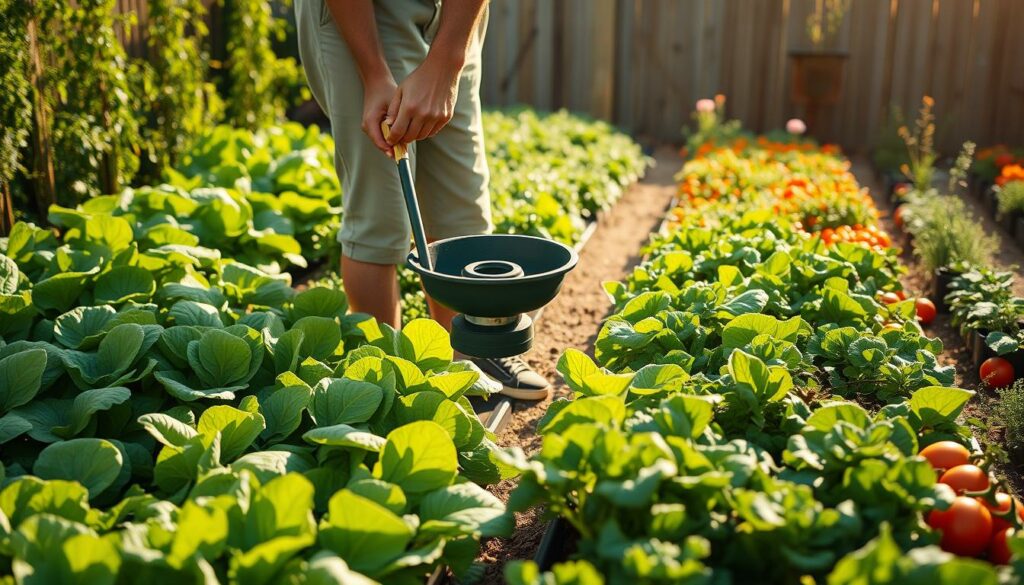
Macronutrients Essential for Growth
The three primary macronutrients are nitrogen (N), phosphorus (P), and potassium (K). Nitrogen drives leafy growth and gives plants a deep green color. Phosphorus supports root development, flowering, and fruit set.
Potassium improves disease resistance, water regulation, and fruit quality. Typical N-P-K ratios guide fertilizer choices. For example, 10-10-10 is balanced, 16-4-8 favors leafy greens with more nitrogen, and 5-10-10 suits root and fruit crops.
Leafy greens like lettuce and spinach prefer higher nitrogen. Tomatoes and peppers benefit from fertilizers with more phosphorus and potassium when fruiting. Secondary macronutrients also matter. Calcium (Ca) builds cell walls and prevents blossom-end rot on tomatoes and peppers.
Magnesium (Mg) is central to chlorophyll and leaf health. Sulfur (S) helps protein synthesis and flavor development in brassicas.
Micronutrients and Their Importance
Micronutrients are needed in small amounts but are vital. Important ones include iron (Fe), manganese (Mn), zinc (Zn), copper (Cu), boron (B), molybdenum (Mo), and chlorine (Cl). Each supports specific plant functions from enzymes to reproduction.
Deficiency signs appear early. Iron chlorosis causes yellowing between leaf veins. Manganese and zinc shortages lead to interveinal yellowing and stunted leaves. Boron deficiency causes distorted growing tips and hollow stems in some crops. Fixing micronutrient shortages prevents yield loss and poor quality.
Balance is critical. Too much of one nutrient can block others. Soil pH affects nutrient availability; most vegetables prefer pH around 6.0–7.0. Adjusting pH helps micronutrients become more accessible and improves fertilizing results.
Soil Testing for Nutrient Levels
Soil testing guides effective fertilization. Local Cooperative Extension services, like county offices, offer reliable lab tests. Home test kits provide quick pH and basic N-P-K readings but have limits, especially with nitrogen.
For thorough assessment, send samples for tests including micronutrients and organic matter. Follow lab instructions carefully: mix cores from several spots, dry them, and use the right container. Results list target nutrient ranges and suggest lime or sulfur to adjust pH plus fertilizer rates.
Practical tips: test soil before planting and every two to three years. Fix pH first, as it affects nutrient uptake. Use soil tests to pick fertilizer type and amount. This reduces waste, prevents nutrient lockouts, and boosts crop growth when fertilizing vegetables.
Types of Fertilizers Available
The market offers many types of fertilizers for different gardens and crops. Choosing the right one depends on soil type, crop needs, and gardener goals. This section explains common choices to help growers pick the best fertilizer for vegetables.
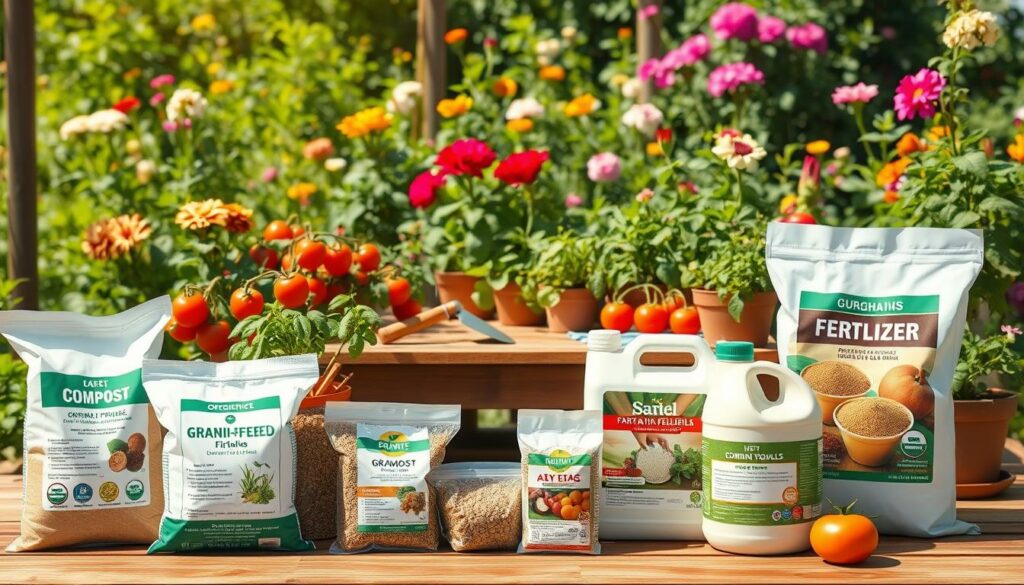
Synthetic vs. Organic Fertilizers
Synthetic fertilizers are made from mineral salts like ammonium nitrate, urea, and superphosphate. They deliver nutrients immediately and have a known analysis. Growers use them to fix deficiencies fast and feed heavy feeders at low cost.
Drawbacks include risks of burning plants if overused and runoff that can harm waterways. Synthetic fertilizers do not add organic matter or feed soil microbes. Brands like Miracle-Gro are common, so users must follow label rates carefully.
Organic fertilizers come from plant, animal, or mineral sources. Examples are compost, blood meal, bone meal, fish emulsion, kelp, and rock phosphate. These improve soil structure and microbial activity and release nutrients slowly, building long-term fertility.
They have less precise nutrient content than synthetic options. Organic feeds are slower to fix acute shortages and sometimes cost more. Popular brands in U.S. garden centers include Espoma, Dr. Earth, and Jobe’s Organics. Many are OMRI certified for organic vegetable fertilizer.
Slow-Release vs. Quick-Release Options
Slow-release fertilizer for vegetables comes in coated granules or natural organic forms. Polymer-coated urea and sulfur-coated urea are common controlled-release synthetics. Organic granular mixes and compost serve as slower nutrient sources.
These fertilizers supply nutrients steadily over weeks or months. They lower nutrient leaching risks. Gardeners who want fewer applications often choose slow-release products for raised beds and in-ground plantings.
Quick-release fertilizers are soluble salts or liquid feeds that work immediately. They are good for quick correction of deficiencies or side-dressing crops like corn during peak growth. Liquids and soluble powders give fast results but need more frequent applications and good timing.
Liquid Fertilizers vs. Granular Fertilizers
Liquid fertilizers include water-soluble powders and concentrates. They can be applied as soil drenches or foliar sprays. Liquids work well for containers, transplants, and foliar feeding during short demand periods.
Granular fertilizers come in organic and synthetic forms. They are broadcast, banded, or mixed into soil for longer feeding. Slow-release granular products reduce how often you apply and are ideal for in-ground beds and perennial vegetables.
Many gardeners use a mixed strategy. Use organic or slow-release fertilizer to build soil, then add quick-release liquid when plants need nutrients fast.
| Type | Examples | When to Use | Pros | Cons |
|---|---|---|---|---|
| Synthetic Quick-Release | Miracle-Gro, soluble salts | Fast correction, heavy feeders | Fast action, predictable N-P-K | Burn risk, no organic matter |
| Synthetic Slow-Release | Osmocote, polymer-coated urea | Long-season beds, low-maintenance | Steady supply, less leaching | Higher up-front cost |
| Organic Granular | Espoma, Dr. Earth, Jobe’s Organics | Soil building, home gardens | Improves soil structure, feeds microbes | Variable nutrient analysis, slower |
| Organic Liquid | Fish emulsion, kelp teas | Seedlings, foliar feeds | Quick uptake, good for foliar use | Short-lived effect, frequent use |
Gardeners should match product choice to crop needs and always follow label directions. Certified organic products are available for those needing organic fertilizer certification. Combining fertilizer types helps maintain yields and soil health while reducing environmental impact.
Best Times to Fertilize Vegetables
Timing makes a big difference for garden nutrition. Knowing when to fertilize vegetables helps plants use nutrients well.
This supports strong yields. A clear fertilizing vegetable garden schedule keeps applications on track from planting through harvest.
Timing Based on Plant Growth Stages
Pre-plant work sets the stage. Incorporate compost or a balanced granular fertilizer into beds before seeds or transplants go in.
At transplant, a mild starter solution with extra phosphorus helps roots take hold. This is a key moment for young plants.
During vegetative growth, apply higher nitrogen feeds for leafy crops. Leafy greens respond well to regular nitrogen applications.
When plants shift to flowering and fruiting, reduce nitrogen compared to phosphorus and potassium. This shift encourages blooms and better fruit set.
Seasonal Considerations
Spring is the main time to feed at planting and again during active growth. Many gardeners start fertilizing in early spring.
In summer, use side-dressings or light top-dressings for long-season crops. Apply liquid feeds every 1–2 weeks during hot, rapid growth.
Fall is best for building soil. Add compost and low-solubility fertilizers to replenish nutrients for next year.
In northern U.S. regions, avoid late high-nitrogen applications that spur tender growth before frost.
Adjusting Fertilization During Harvest
When harvest begins, cut back high-nitrogen feeds for some crops to slow excessive leaf growth. This helps fruit quality improve.
Continuous producers like beans and cucumbers need steady feeding to sustain yields. Keep a regular vegetable fertilizer schedule for these crops.
Harvest removes nutrients from the soil. Plan to replenish with compost or balanced fertilizer after the season to restore fertility.
| Growth Stage | Recommended Action | Frequency |
|---|---|---|
| Pre-plant | Incorporate compost or balanced granular fertilizer for baseline nutrients | Once, before planting |
| Transplant | Apply gentle starter solution high in phosphorus to aid root establishment | At planting |
| Vegetative | Use higher nitrogen for leafy growth; side-dress heavy feeders | Every 3–6 weeks or liquid every 1–2 weeks |
| Flowering/Fruiting | Reduce nitrogen, increase phosphorus and potassium to promote blooms and fruit | At bloom and fruit set; follow with periodic feeds |
| Harvest | Reduce high-N feeds for some crops; continue feeding continuous producers | Adjust per crop; replenish soil after harvest |
How to Apply Fertilizers Effectively
Proper application keeps nutrients where plants need them. It also reduces waste. This guide covers methods, tool tips, and safety for gardeners.
It offers clear, practical directions on applying fertilizers to edible plants.
Application techniques for different types
Broadcasting spreads granular fertilizer evenly across a bed. It suits prepared soil and quick coverage for lawns and large vegetable patches.
Banding places fertilizer in narrow strips near seed rows or transplant lines. Use it at planting time to support young roots.
Side-dressing adds nutrients beside established plants during the season. This method boosts plants without disturbing roots.
Soil application best practices
Start with a soil test. Then follow recommended rates using label guidance or extension tables.
Incorporation mixes fertilizer into soil before planting to avoid surface losses. Granular products work well when tilled in.
Slow-release granules can be applied at planting or left on the surface.
Calibrate spreaders and aim for even coverage to prevent nutrient hotspots. Do not apply dry fertilizers to drought-stressed plants.
Water thoroughly after applying to move nutrients into the root zone.
Foliar feeding techniques
Foliar feeding helps correct micronutrient shortages and delivers rapid uptake. Use it as a supplement, not the main feeding method.
Dilute foliar fertilizers to label concentrations. Spray in early morning or late afternoon to reduce leaf burn.
Avoid spraying during peak heat or when pollinators visit flowers.
Step-by-step side-dressing
- Check label or extension recommendations for rate per plant or per foot of row.
- Measure and place fertilizer 2–4 inches from stems and 1–2 inches deep to protect roots and stems.
- Water immediately after application to carry nutrients into the root zone.
Fertigation and liquid options
Liquid fertilizers work as soil drenches or through fertigation systems. They provide quick nutrient delivery and controlled feeding schedules.
Follow concentration and system calibration instructions closely.
Choosing technique by fertilizer type
Granular fertilizers are often broadcast, banded, or incorporated. Slow-release granules work well at planting or on the surface for steady release.
Liquid formulas are best for drenching, foliar sprays, or fertigation.
Safety and handling
Wear gloves and eye protection when handling concentrated fertilizers. Store products in original containers and follow disposal instructions.
Keep products away from children and pets.
Practical checklist
| Task | When to Use | Why It Helps |
|---|---|---|
| Broadcast | Pre-plant or large beds | Quick, even coverage for many plants |
| Banding | At planting beside seed rows | Concentrated feed near roots for seedlings |
| Side-dressing | Mid-season growth spurts | Targeted boost without digging up plants |
| Top-dressing | Established beds and mulched rows | Slow nutrient release and easy application |
| Fertigation/liquid drench | When quick uptake is needed | Controlled delivery through irrigation |
| Foliar feed | Micronutrient deficiency or quick correction | Fast absorption via leaves |
Using these methods and soil best practices helps gardeners apply nutrients precisely.
When gardeners use the right technique, plants grow steadier and give higher yields.
Signs of Nutrient Deficiency in Plants
Plants send clear signals when they lack key nutrients. Gardeners who learn to spot signals can act fast to protect yields and flavor.
The short guide below helps identify symptoms. It also outlines steps for correcting shortages and monitoring plant health over time.
Identifying Common Deficiencies
Nitrogen deficiency shows as older leaves yellowing from the tip inward. It also causes stunted growth. Phosphorus issues often cause purpling of leaves or stems.
Poor root development and delayed maturity are other signs of low phosphorus. Potassium shortage appears as marginal scorch or yellowing. It also causes weak stems and poor fruit quality.
Calcium lack produces blossom-end rot on tomatoes and peppers. It also leads to distorted new growth. Magnesium deficiency shows interveinal yellowing on older leaves and leaf curl.
Iron deficiency causes interveinal chlorosis in new growth, while veins stay green. Boron shortage can lead to misshapen growing tips and hollow stems in some crops.
How to Correct Nutrient Shortages
Begin by comparing symptoms to typical patterns for identifying vegetable deficiencies. Use a soil test and pH reading before applying large doses.
Review recent fertilizer and watering history to rule out over- or under-application. Also, check for pests and diseases that mimic nutrient problems.
Targeted amendments work best. For nitrogen, add a balanced fertilizer or compost. For phosphorus, consider bone meal or rock phosphate. These act slowly.
For potassium, use potassium sulfate or a light application of wood ash. Use wood ash sparingly. Adjust soil pH with lime for low pH or sulfur for high pH.
This improves nutrient availability. Micronutrient shortfalls respond quickly to foliar sprays. Use chelated iron for iron chlorosis and specialized mixes for zinc or manganese as labeled.
For blossom-end rot, keep watering consistent. Add calcium via gypsum or calcium nitrate. Avoid excess nitrogen that fuels rapid fruit growth without calcium uptake.
Monitoring Plant Health Over Time
Keep a garden journal to record fertilizer applications, soil test results, and visual observations. Photograph symptoms and note dates to track progress after treatments.
Re-test soil if problems persist after corrective actions. Regular checks help catch early signs of nutrient deficiency and reduce crop loss.
Simple, consistent notes let gardeners fine-tune fertilization and improve long-term monitoring of plant health.
| Symptom | Likely Deficiency | Diagnostic Step | Typical Fix |
|---|---|---|---|
| Older leaves yellow from tip inward | Nitrogen | Soil nitrate test; review recent compost or fertilizer | Apply compost or balanced N fertilizer; steady watering |
| Purple leaves or stems; poor root growth | Phosphorus | Soil P test; check soil temperature and compaction | Work in bone meal or rock phosphate; improve drainage |
| Marginal scorch; weak stems; poor fruit | Potassium | Soil K test; rule out salt damage | Apply potassium sulfate; use wood ash sparingly |
| Blossom-end rot; distorted new growth | Calcium | Check soil Ca and pH; review watering pattern | Even irrigation; gypsum or calcium nitrate; reduce excess N |
| Interveinal yellowing on older leaves | Magnesium | Leaf tissue test; consider soil pH | Apply Epsom salts or dolomitic lime if pH allows |
| Interveinal chlorosis on new leaves | Iron | Soil pH check; leaf tissue analysis | Use chelated iron foliar spray or soil amendment |
| Misshapen tips; hollow stems | Boron | Soil micronutrient test; inspect root health | Apply borax in small, labeled amounts; follow crop guidelines |
The Role of Compost in Vegetable Fertilization
Compost forms the base for healthy vegetable beds. It provides slow-release nutrients and improves soil structure. It also increases water-holding capacity and supports beneficial microbes.
Gardeners who use compost notice stronger roots and steadier plant growth when it is applied correctly.
Benefits of Adding Compost to the Soil
Compost offers vegetables a steady nutrient supply that lowers the need for synthetic inputs. It improves tilth, which enhances root development and aeration. Compost boosts cation exchange capacity, helping soil hold nutrients better for plant use.
It also reduces erosion and runoff by improving soil aggregation. Compost feeds soil life, which supports plant health and builds resilience.
How to Make and Use Compost
Home composting mixes carbon-rich “browns” like dry leaves with nitrogen-rich “greens” such as vegetable scraps. Aim for about a 25–30:1 carbon-to-nitrogen ratio. Keep the pile damp but not soggy.
Methods vary from a simple pile to a tumbler or aerated bin. Turning speeds decomposition. Well-managed piles finish in 3–12 months depending on care and materials. Hot composting reaching 131–160°F controls pathogens and weed seeds.
Use finished compost by mixing 1–3 inches into topsoil before planting. Apply as side-dress or top-dress during the season. Compost tea can be used sparingly as a microbial boost. For container vegetables, mix no more than 20–30% finished compost into potting mixes to avoid too much water retention.
Composting Mistakes to Avoid
Avoid adding meat, dairy, or oily foods unless the system handles them. Do not include diseased plants or weed seeds unless the pile gets hot enough.
Do not over-apply immature compost; it can tie up nitrogen and stunt growth. Avoid too much high-carbon material without balancing greens because this slows decomposition. Relying only on compost without soil tests can miss needed nutrient supplements.
| Topic | Best Practice | Common Mistake |
|---|---|---|
| Carbon-to-Nitrogen Ratio | Target 25–30:1 using a mix of browns and greens | Using mostly browns causes slow breakdown |
| Moisture | Keep damp but not soggy; aim for a wrung-out sponge feel | Letting pile dry or become waterlogged halts activity |
| Temperature | Reach 131–160°F for pathogen and seed control | Cold piles may preserve weed seeds and pathogens |
| Application Rates | Incorporate 1–3 inches into soil; 20–30% in containers | Over-applying immature compost ties up nitrogen |
| Use as Fertilizer | Combine with occasional targeted feeds based on tests | Relying solely on compost without soil testing |
Incorporating Fertilization into a Garden Plan
A clear garden plan ties soil testing, timely feeding, and crop choices into one workable routine. Start with a simple annual map that lists beds, crops, and a basic fertilization schedule. Keep entries brief so records stay useful through the season.
Creating a Fertilization Schedule
Use soil test results to set targets for nitrogen, phosphorus, and potassium before planting. Plan a pre-plant amendment, a planting-time starter, mid-season side-dressings, and post-harvest soil-building applications.
For common U.S. backyard crops, a sample fertilizer schedule might include spring planting amendments and nitrogen boosts for leafy greens every 3–4 weeks. Phosphorus and potassium are key at bloom for tomatoes. Apply a mid-season side-dress for corn and squash.
Track each application with a short log: date, product used, rate, placement method, and observed plant response. These notes make it easier to refine your schedule yearly.
Rotational Cropping and Its Benefits
Rotational cropping reduces pest and disease buildup and evens out nutrient demand across the plot. Rotate plant families so heavy feeders, like tomatoes or corn, follow legumes that add nitrogen.
Aim for a 3–4 year rotation. Group crops as heavy, moderate, or light feeders. Move families between beds each season. Include cover crops like clover or vetch to add nitrogen, and rye or daikon radish to capture deep nutrients.
Companion Planting for Nutrient Enhancement
Companion planting can boost local fertility when part of a proper plan. Pair beans with corn so legumes increase nitrogen near heavy feeders.
Use dynamic accumulator plants such as comfrey for chop-and-drop mulch. This recycles minerals into the root zone. Place nitrogen-fixing plants in borders or interplant them to improve soil in key spots.
Remember that companion planting nutrients give modest gains and do not replace a full fertilizer schedule. Combine interplanting with cover crops, composting, and regular feeding for best results.
| Plan Element | Timing | Typical Action | Notes |
|---|---|---|---|
| Pre-plant amendment | Late winter / early spring | Apply compost and base organic fertilizer | Adjust rates from soil test |
| Planting-time starter | At transplant or seeding | Small starter fertilizer or inoculant for legumes | Use for root development |
| Mid-season side-dress | 3–6 weeks after planting | Nitrogen boost for leafy crops; balanced feed for fruiters | Follow specific crop needs |
| Bloom/fruit stage | At first flowers | Emphasize phosphorus and potassium | Important for tomatoes, peppers, squash |
| Post-harvest soil building | After final harvest | Plant cover crop or add compost | Prepares beds for winter and next season |
| Rotation interval | 3–4 years | Move crop families between beds | Reduces disease, balances nutrient drawdown |
| Record keeping | Ongoing | Log dates, rates, products, placement, responses | Key to refining fertilization schedule |
Environmental Considerations When Fertilizing
Fertilizing edible plants boosts yields, but careless use risks soil, water, and community health. Gardeners should consider environmental effects to protect waterways and soil life. Small changes in timing and method reduce harm and keep gardens productive.
Avoiding Runoff and Pollution
Nutrient runoff sends nitrogen and phosphorus into streams and lakes. This causes eutrophication and algal blooms that harm fish and wildlife. Runoff risk rises with over-application, rain, and slope broadcasting.
Best practices limit nutrient losses. Apply fertilizers when plants actively take up nutrients. Incorporate granular products or water them in so nutrients reach roots.
Use buffer strips, mulches, and groundcover to trap sediment and nutrients. Follow soil test recommendations and label rates. Avoid spreading fertilizer before heavy rain to protect water bodies.
Impact of Over-Fertilization
Too much fertilizer causes nutrient burn and weakens plants. This increases pest and disease problems. Excess nitrogen can raise nitrate levels in leafy vegetables, lowering produce quality.
Leaching moves nitrates into groundwater, causing health and regulatory concerns. Soil microbes suffer when salts and nutrients are overused. Over-fertilization wastes money and risks neighbor complaints if runoff occurs.
Careful measurement and timing reduce over-fertilization impacts and protect gardens and communities.
Plant-Friendly Alternatives
Natural vegetable fertilizers maintain soil biology while supplying nutrients. Options include compost, manure, cover crops, bone meal, rock phosphate, kelp meal, and fish emulsion. These sources release nutrients slowly and support beneficial microbes.
Integrated approaches combine slow-release organic sources with precise methods like banding and fertigation at recommended doses. Reducing high-salt synthetic products in sensitive areas limits harm.
Conservation practices help too. Mulching cuts surface runoff, groundcovers hold soil, and rain gardens capture water for infiltration. These measures create resilient gardens with less pollution risk.
| Concern | Common Cause | Practical Fix |
|---|---|---|
| Runoff to waterways | Broadcasting before heavy rain; slopes | Apply when plants can use nutrients; use buffer strips and mulches |
| Nitrate leaching | Excess nitrogen, sandy soils | Use slow-release sources; follow soil test rates; band applications |
| Plant nutrient burn | Over-application, high-salt fertilizers | Reduce rate; switch to organic options like compost or fish emulsion |
| Soil microbial imbalance | Repeated synthetic fertilizer use | Add compost and organic matter; use cover crops |
| Lower produce quality | Excessive fertilization, especially nitrogen | Soil test-guided fertilizing; use natural vegetable fertilizer sources |
Tools and Equipment for Fertilizing
The right gear makes fertilizing easier and more precise. This short guide highlights practical picks for everyday gardeners. It focuses on tools for fertilizing and how to use soil test kits properly.
Essential tools keep your work safe and efficient. A hand trowel suits small-scale applications. Measuring cups or a digital kitchen scale ensure accurate fertilizer amounts.
A watering wand or hose with a shutoff helps with fertigation. A garden fork or rototiller aids soil incorporation. A wheelbarrow moves compost and amendments without strain.
Safety gear matters. Wear sturdy gloves and a dust mask if handling dry fertilizers. Always use eye protection. Clean tools after use to stop cross-contamination between organic and synthetic materials.
Essential Gardening Tools for Fertilization
Practical choices save time and reduce waste. Handheld seed spreaders work well in raised beds and small plots. Broadcast push spreaders cover larger beds and lawn strips quickly.
Drop spreaders give precise lines of granules near rows. Handheld squeeze-type spreaders let gardeners target individual plants.
- Hand trowel — targeted placement.
- Measuring cups or scale — accurate dosing.
- Watering wand or hose with shutoff — even watering and fertigation control.
- Garden fork or rototiller — incorporate amendments.
- Wheelbarrow — move soil, compost, and bags.
How to Use Soil Test Kits
Home kits cover pH and basic N-P-K. They provide quick guidance for routine adjustments. For thorough analysis, send samples to a Cooperative Extension lab.
Lab tests return nutrient levels and fertilizer recommendations by pounds per 1,000 sq ft or per row.
- Collect samples from several spots and depths, usually 0–6 inches.
- Mix samples to form a composite, then follow kit directions for testing.
- Compare results to the kit chart. If unclear, send a sample to the lab.
- Include crop type and field history with the lab submission form.
Home kits are fast and inexpensive. Extension labs provide detailed calibration for local soils and crops. Use both options together to improve fertilization plans.
Choosing the Right Fertilizer Spreader
Select a spreader that matches your garden size and fertilizer type. Small gardens benefit from handheld seed spreaders or squeeze-style devices. Medium to large plots work best with a broadcast push spreader.
Drop spreaders suit row crops and precise applications like vegetable beds. Look for adjustable settings and clear calibration instructions. Clean spreaders after use, especially when switching fertilizer types, to avoid contamination.
| Spreader Type | Best Use | Key Feature |
|---|---|---|
| Handheld seed spreader | Small plots, container gardens | Lightweight and portable |
| Broadcast push spreader | Larger beds and lawns | Wide coverage with adjustable settings |
| Drop spreader | Precise row applications | Minimal drift, accurate placement |
| Squeeze-type handheld spreader | Targeted granular control | Easy single-plant feeding |
Calibrate before first use. Measure a known area, apply fertilizer at a trial setting, then weigh or collect the output. Compare this to the fertilizer’s labeled rate.
Adjust settings until the spreader delivers the right pounds per 1,000 sq ft or per plant row. Regular calibration keeps rates accurate and reduces waste from over-fertilizing vegetables.
Common Myths About Fertilizing Vegetables
Many gardeners follow simple rules that don’t fit every garden. This section looks at common myths about fertilizing vegetables. It shows how evidence-based practices lead to better harvests.
Thoughtful soil care matters more than repetitive feeding.
Debunking Popular Fertilization Misconceptions
One myth is that more fertilizer always means bigger crops. Too much fertilizer can burn roots and push leaf growth over fruit production. It can also invite pests and disease.
Another myth says yellow leaves always mean a need for nitrogen. Yellowing can come from pH imbalance, micronutrient shortages, poor drainage, or root damage. Testing soil before adding nitrogen is important.
Some believe organic fertilizers act slowly or are ineffective. This is false; blood meal and fish emulsion supply nutrients quickly and build soil health over time.
Lastly, fertilizer formulas are not one-size-fits-all. Different crops and growth stages need tailored N-P-K and micronutrient mixes based on soil tests.
Understanding Soil Health
Soil health is more than just nutrient numbers. Healthy soil has good structure, active microbes, earthworms, steady water infiltration, and organic matter content.
This kind of soil cushions nutrient swings and supports strong plants. It reduces the need for heavy fertilization. Simple signs like crumbly soil and visible biological activity help gardeners judge soil health without laboratories.
Encouraging Sustainable Practices in Gardening
Sustainable gardening uses compost, cover crops, crop rotation, and precise fertilizer applications based on soil tests. Gardeners should follow label directions to prevent runoff. Reusing organic materials helps close nutrient loops.
Local Cooperative Extension services and university publications offer regional advice to refine gardening practices. By debunking fertilizer myths and focusing on soil health, gardeners get reliable yields with fewer inputs over time.